One app. Every model.
A free, private desktop app. leap sends each prompt to the cheapest of 330+ models that can actually handle it, and you can start at $0 on free models. Your keys and your chats stay on your machine.
- models
- 330+ models
- labs
- 50+ labs
- countries
- 7 countries
Free models are capped by OpenRouter at 50 requests a day, or 1,000 after a one-time $10 top-up. The free allowance
Signed and notarized by Apple · macOS, Windows, Linux
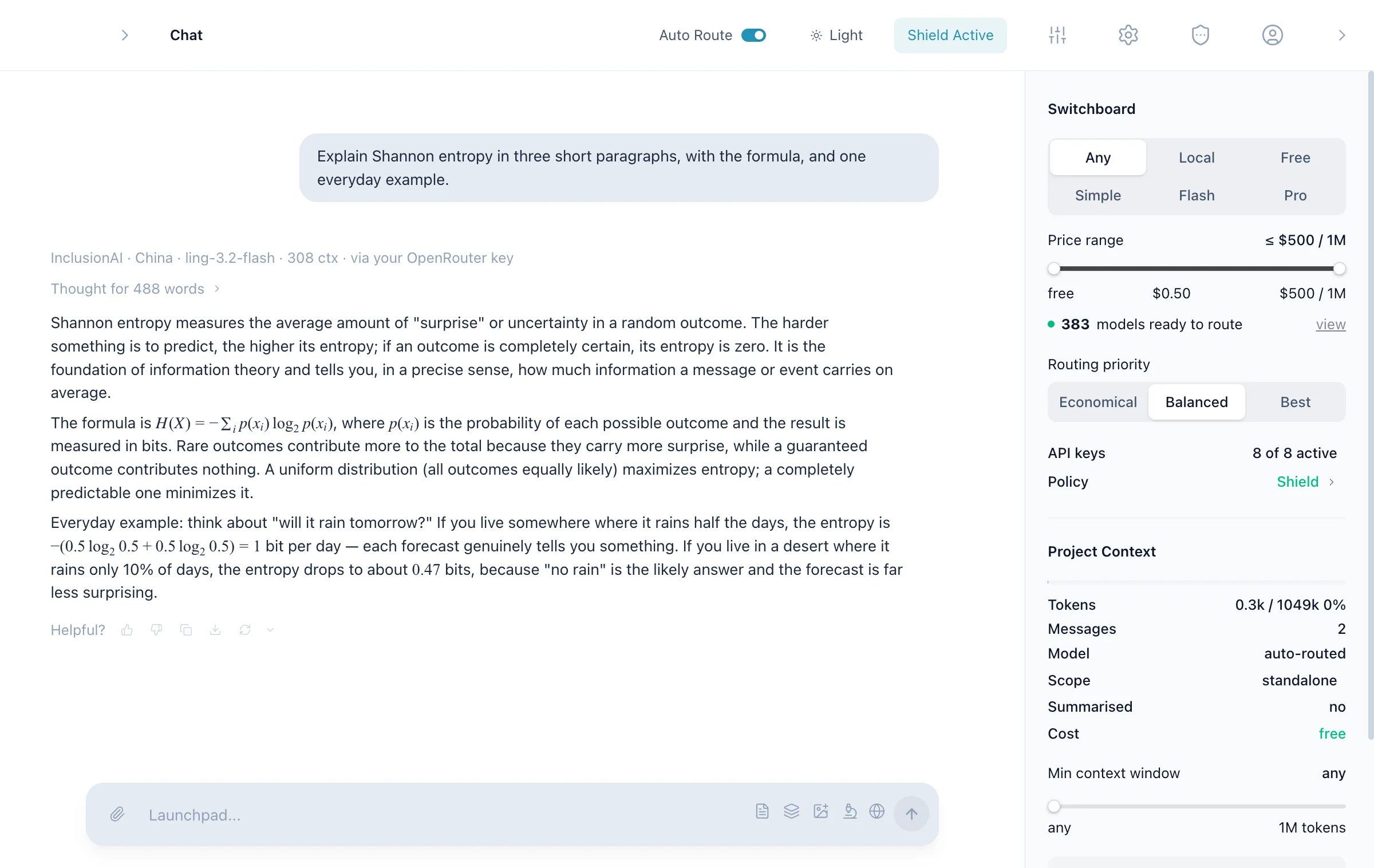
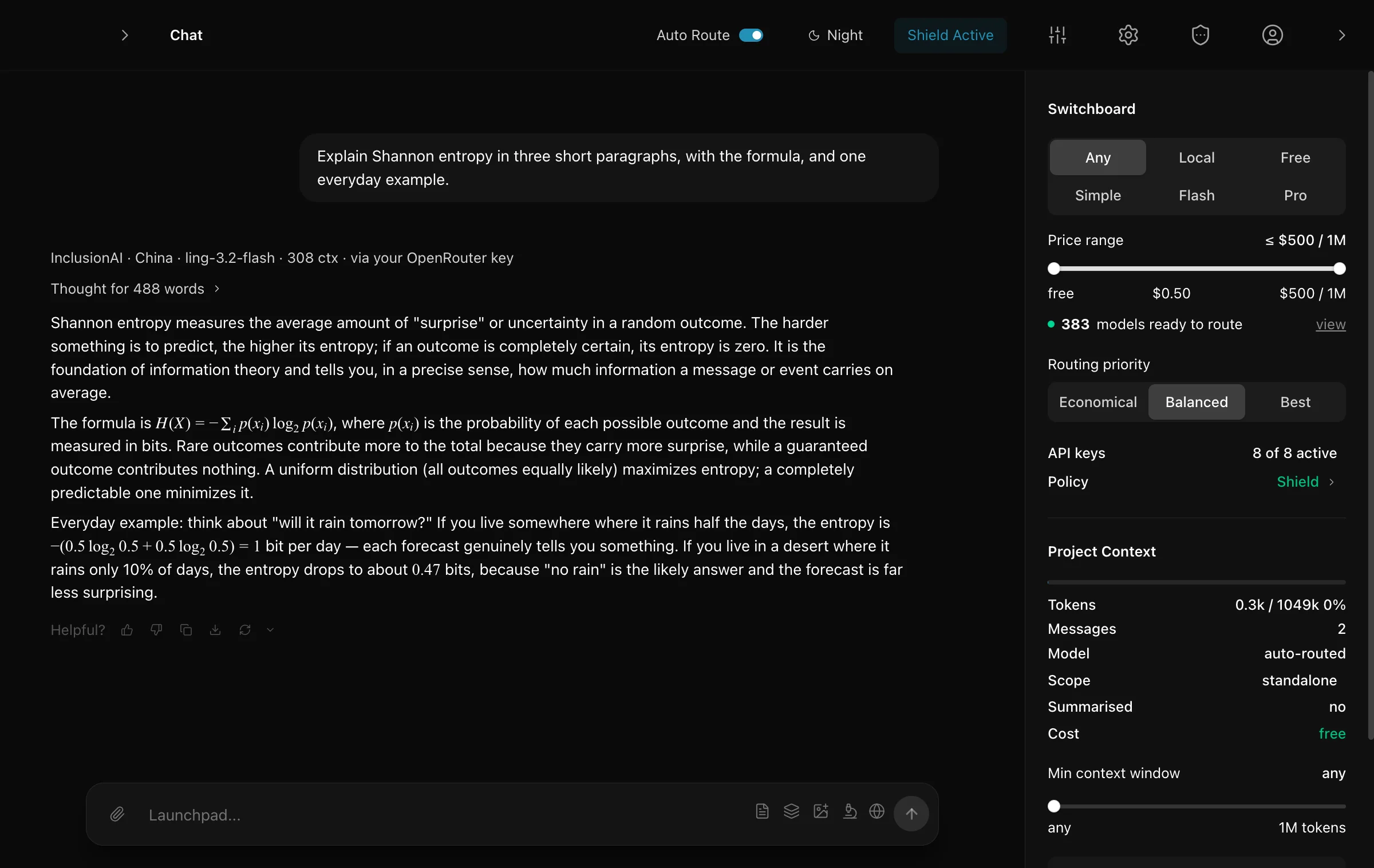
How it works
Four things happen to every prompt
Choosing by hand means frontier rates on easy turns and weak answers on hard ones. Set your limits once, and every request is costed, protected and logged without another thought.
Switchboard
You set the ceiling
Name a maximum price per million tokens, choose which vendors may see your work, demand capabilities like vision or tool use, and narrow by country. Everything downstream obeys those limits.
Routing
It picks the cheapest model that can do the job
Each prompt is read for task type, length and required capabilities, then measured against the catalogue that survived your rules. The least costly candidate clearing a quality bar wins, and a circuit breaker steps around vendors that are failing.
DataShield
Personal details are masked before they leave
Outbound text is scanned on your device by a deterministic recogniser, plus a language-model pass when a local model is running on this machine. What it finds is swapped for a placeholder before the request goes out, then restored in the answer you read. It covers common personal data, not every possible case.
Event Stream
You can prove all of it afterwards
Every turn is recorded on your device: which model replied, which key paid, how many tokens moved, the true cost, and how much got masked. Filter the table, export it as CSV, audit exactly what left.
None of it is a black box: the routing trace names every model considered, the rule that eliminated each one, and what the winner charged. How the router decides →
Features
What you get
Routing is the engine, not the whole product. leap gives you somewhere to work, grouping threads, bringing in files, looking things up, and holding personal details back, rather than a thin wrapper over one API.
Every provider, one interface
OpenAI, Anthropic, Google and OpenRouter behind one chat. Hold a vendor’s own key and leap calls that service directly; without one, requests travel through the aggregator.
Switchboard
Set price floors and caps, allow or block individual providers, require capabilities like vision or tool use, and filter by country. The router obeys all of it.
Sign in, or bring your own keys
Connect with OpenRouter in a single click, nothing to paste, or add your own OpenAI, Anthropic and Google credentials. Each is sealed in the OS keychain and used straight from your device, with no proxy in between and no cut taken.
DataShield
Scans outbound prompts for names, emails and secrets, masks them before the request leaves your device, and restores them in the reply.
Search and deep research
Web lookups with no third-party key required, plus a multi-step mode that plans, queries and synthesises across several model calls.
A real workspace
Group chats into projects, drop in documents for retrieval, watch token usage in the context view, and compact long threads when they get expensive.
Cost
What this actually costs
leap charges nothing and takes no share, so your bill is only what the models themselves charge. Everything about the routing exists to keep that number small.
Signing in with OpenRouter
One click opens OpenRouter’s own sign-in page. Approve leap and it hands back an API key scoped to this app, spend-limited and revocable from your dashboard at any moment. No password reaches us, nothing needs pasting, and a single account unlocks the whole catalogue rather than a separate billing relationship per lab.
Or bring your own Anthropic, OpenAI and Google keys
All three work today, alongside OpenRouter or instead of it. Paste a key into Settings and leap seals it in the OS keychain, then calls that lab’s own API directly from your machine. You are billed by the lab at its own rate, with no aggregator in the middle and no cut to us.
A partial set is the normal case, not a compromise. leap sends each prompt down whichever path is cheaper: direct when your own credentials cover the model, through OpenRouter when they don’t.
The free allowance, precisely
OpenRouter grants a daily quota on models whose identifier ends in :free. How large depends on one thing only: whether you have ever bought credit.
| Never bought credit | After $10, once | |
|---|---|---|
| Free-model requests per day | 50 | 1,000 |
| Requests per minute | 20 | 20 |
That threshold is a one-time unlock, not a balance to maintain. Buy ten dollars of credit once, draw it down to nothing, and the larger daily quota stays with the account permanently.
Worth knowing: only identifiers carrying that suffix draw on the allowance. Drop it and you are calling a separate catalogue entry, billed at its ordinary rate, which is why the Free-only budget in leap targets those marked variants specifically.
Twenty a minute is more than a person types. For most days the ceiling never comes into view, and your credit goes to the handful of prompts that genuinely warrant a frontier model.
Privacy
Your keys, your machine
leap is a desktop app, not a hosted service. There is no leap account and no leap server between you and the model provider.
- Chats and settings are stored locally on your device
- Provider keys are encrypted with the OS keychain
- Requests go straight from your machine to the provider you chose
- DataShield masks personal data before a prompt is sent
- One switch turns on zero data retention: Leap then only uses providers that honour it
FAQ
Questions people ask
What is leap?
leap is a free desktop AI app for macOS, Windows and Linux. It sends each prompt to the cheapest model that can handle it, choosing from 330+ models by 50+ labs, and it runs on your own API keys.
How does leap pick a model for each prompt?
It reads the prompt for task type, length and required capabilities, filters the catalogue by your Switchboard rules (price cap, providers, countries, context window), and picks the least expensive candidate that clears a quality bar set by its Leap score. A circuit breaker steps around providers that are failing.
What is the Leap score?
Leap's own 0 to 100 rating of a model's general ability, worked out the same way for every model. It is built from independent evaluations published under open licences, Epoch AI's Capabilities Index and OpenRouter's own benchmark runs (both CC BY 4.0), together with the results labs publish for their own models. The app shows the rating, not the figures behind it.
Is leap free?
Yes. The app is free and takes no cut. Paid models are billed by the provider at its own rate on your key. Free OpenRouter models cost nothing: 50 requests a day, or 1,000 after a one-time $10 top-up.
Which AI providers and models does leap support?
One OpenRouter key reaches every model in the catalogue. You can also add direct keys for OpenAI, Anthropic, Google Gemini, Mistral, DeepSeek, Groq, NVIDIA NIM, xAI and others, and run local models through Ollama or LM Studio.
Does leap see my prompts or my API keys?
No. leap runs on your computer, has no account and sends no telemetry. Keys are encrypted in the operating system keychain, and requests go straight from your machine to the provider you chose.
How is leap different from using ChatGPT or OpenRouter directly?
Those leave the choice of model to you. leap makes it per prompt, by cost and capability, uses a lab's own API when you hold its key, masks personal data before sending, and records which model answered, which key paid and what it cost.
Can leap keep personal data out of my prompts?
DataShield masks common personal data, such as emails, card numbers, addresses and API keys, on your device before a prompt leaves it, and restores it in the reply. It is pattern-based, so it lowers the risk rather than removing it. A separate switch turns on zero data retention.
Does leap work offline?
Yes, with a local model. Point leap at Ollama, LM Studio or another OpenAI-compatible runtime on your machine and the Local tier answers without any network request.